
OneUpWithNichole
Esports—Beyond the Game
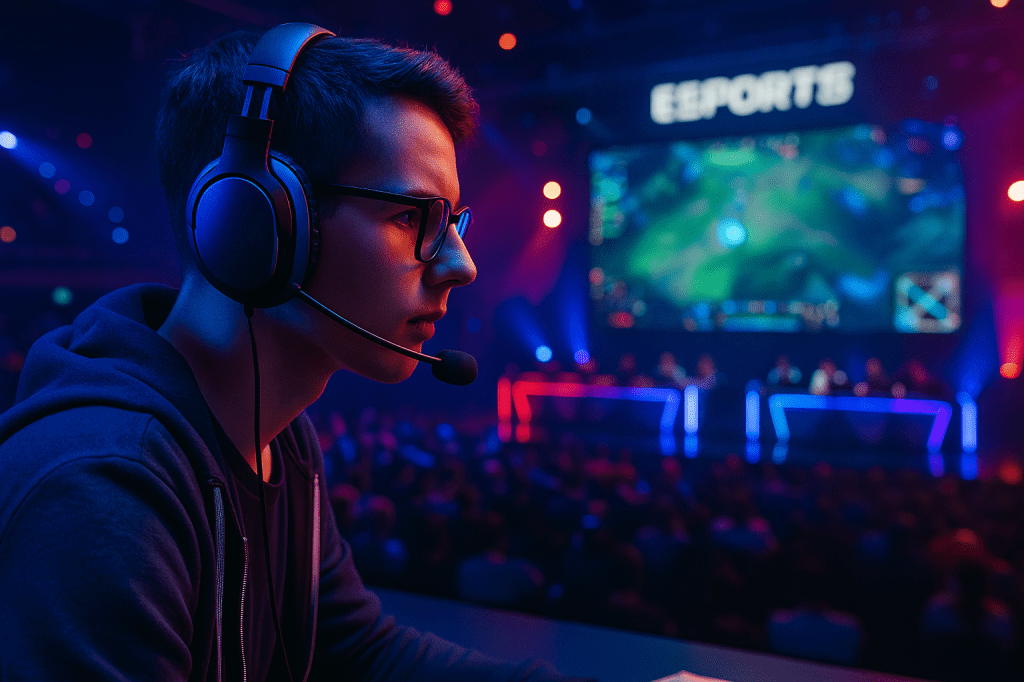
If there’s one thing Units 5 and 6 proved, it’s that esports isn’t just competitive, it’s a full-blown ecosystem, a cultural mirror, and a growing global industry that’s rewriting the rules of entertainment and identity.
One of the most fascinating takeaways is how gaming culture, especially in esports, has evolved into something way more layered than just players and tournaments. We’re talking about identities, perceptions, and communities that stretch across countries and blur traditional social lines. For example, Blackburn and Scharrer (2019) highlight how male and female gamers form beliefs about masculinity differently, showing how gaming is entangled with gender expectations. Esports isn’t just a digital playing field, it’s a social arena where gender, identity, and belonging are shaped.
Another key point? The role of community in moderating gaming spaces. Brewer, Romine, and Taylor (2020) explore how Twitch, a dominant platform for esports, has turned moderation into a collaborative, crowd-driven effort. This is massive. Rather than relying solely on top-down censorship, platforms are empowering users to set the tone and protect their own spaces. It’s digital democracy in action, and it’s reshaping how people interact with content and each other.
But what does this tell us about the esports ecosystem? It’s not just about flashy graphics and million-dollar prize pools. It’s about shared identity, digital governance, and navigating a very real social world inside a virtual one. And like any complex ecosystem, it has cracks. The political landscape of gaming is still turbulent. Robinson (2012) critiques how legislative efforts to control video game violence often stem from moral confusion rather than actual data. This kind of misplaced regulation can stifle innovation and cultural progress.
Now here’s the global twist, how esports exists beyond U.S. borders. Scholz (2019) points out that the structure of esports overseas, especially in South Korea and parts of Europe, is more institutionally supported and culturally integrated than it is in the U.S. While America still wrestles with whether gaming counts as a “real sport,” other nations have government programs, career pipelines, and normalized esports education. The U.S. may dominate streaming platforms and media exposure, but internationally, esports is treated more seriously as both an economic and cultural force (Rogers, 2019).
So, where do we go from here? The esports industry needs to do a better job ensuring diversity, both in who gets to play and who gets visibility. There’s still a lot of gatekeeping, and while community-led moderation is a step forward, major platforms need to do more to uplift marginalized voices. And let’s not forget infrastructure, training, education, and professional development that actually match the scale of this global juggernaut.
Now here’s my question to you, reader:
If gaming continues to evolve as both a career and cultural identity, what responsibilities do players, platforms, and even governments have in shaping the future of esports? Should it be treated like traditional sports, with regulation, scholarships, and unions, or stay wild and decentralized?
References
Blackburn, G., & Scharrer, E. (2019). Video game playing and beliefs about masculinity among male and female emerging adults. Sex Roles, 80(5/6), 310–324. https://doi.org/10.1007/s11199-018-0945-6
Brewer, J., Romine, M., & Taylor, T. L. (2020). Inclusion at scale: Deploying a community-driven moderation intervention on Twitch. DIS2020.
Fried, G., Hedlund, D., & Smith, R. (2020). Esports business management. Human Kinetics.
Robinson, N. (2012). Video games and violence: Legislating on the “Politics of Confusion.” Political Quarterly, 83(2), 414–423. https://doi.org/10.1111/j.1467-923X.2012.02279.x
Rogers, R. (2019). Understanding esports: An introduction to the global phenomenon. Lexington Books.
Scholz, T. (2019). Esports is business: Management in the world of competitive gaming. Palgrave Macmillan.
 OneUpWithNichole
Leave a comment